

Squat Variations: How Belt Squats, Hack Squats and Barbell Squats Support Lower-Body Strength


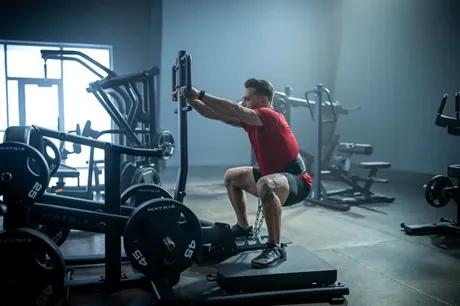
Facilities increasingly serve a wider range of ages, abilities, and training backgrounds. While the squat remains one of the most effective lower-body exercises, the limiting factor for many members is not leg strength itself. Challenges with balance, shoulder mobility, confidence, and tolerance to spinal loading can all restrict progression. In some cases, the barrier is not physical capacity but confidence with a particular loading method or exercise environment.
By offering multiple squat variations, gyms can help more members continue progressing by offering equipment options that change how load is supported, stabilized, and distributed within the same fundamental movement pattern. These differences in equipment and loading can substantially change the demands of the movement and the experience of the lifter. Because of this, the barbell back squat, hack squat, and belt squat can each serve different roles within fitness facilities, helping them accommodate a broader range of training needs.
Barbell Squat: The Traditional Standard for Lower-Body Strength

The traditional barbell back squat combines lower-body force production with substantial stabilization demands. Successful execution also requires adequate shoulder mobility to support the bar and sufficient ankle mobility to achieve depth while maintaining position. These characteristics make the barbell back squat particularly valuable for exercisers seeking integrated strength development, where lower-body force production, trunk stability, balance, and coordination are trained simultaneously.
With the load positioned across the upper back, the torso must resist flexion to maintain spinal position throughout the movement, engaging the lower back muscles. During the descent, most lifters lean forward, increasing demands on spinal stabilizers, though some maintain a more upright posture that can shift more of the work to the quadriceps. 1
Compared to more supportive squat variations like the hack squat, the barbell squat leads to greater trunk muscle activation, including the abdominal muscles and spinal erectors.2 These demands contribute to strength development across the torso and posterior chain, but they can also make the movement feel more challenging than supported squat variations.
Hack Squat: A Squat Variation for Quadricep Development
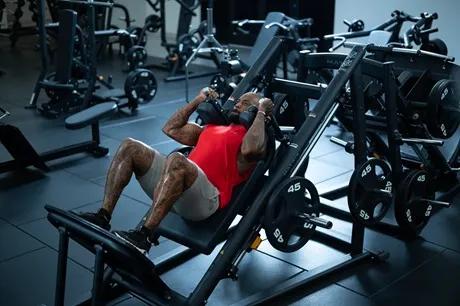
The hack squat positions the exerciser against a padded back support with the load transferred through shoulder pads attached to the machine. The shoulder pads and back support guide the movement pattern rather than requiring the exerciser to stabilize a free-moving barbell. As a result, the lifter requires less balance and stabilization while increasing the relative contribution of the quadriceps.3 This may make the exercise particularly appealing for newer exercisers or those whose primary goal is lower-body strength and hypertrophy.
Belt Squat: A Lower-Body Exercise That Reduces Upper-Body Loading
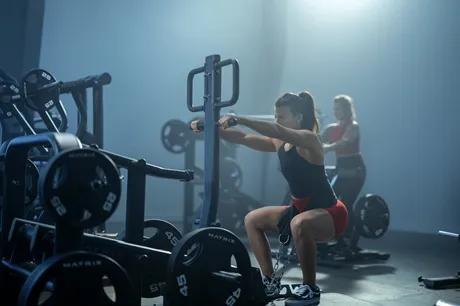
The belt squat applies resistance through a belt secured around the pelvis rather than through a load positioned across the shoulders and spine. This shifts the load away from the upper body while still allowing substantial resistance through the hips and knees. This makes the movement a valuable option for facilities programming squat exercises for glutes and overall lower-body strength development. For exercisers who are limited by shoulder or upper-back discomfort, belt squats provide another way to continue lower-body resistance training.
Research comparing hip belt squats with traditional back squats found broadly similar activation across major lower-body muscle groups, including the quadriceps, gluteal, and hamstrings.4 Because the load is transferred through the pelvis rather than the upper back, belt squats may allow heavy lower-body training without requiring the shoulders and spine to support the load.
Barbell Squat vs Hack Squat vs Belt Squat: Choosing the Right Squat Variation
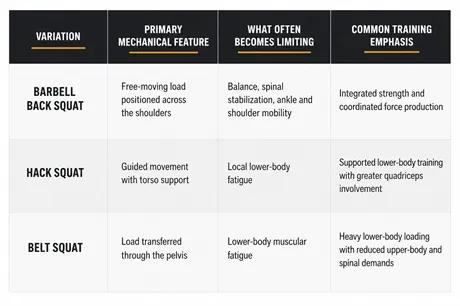
Different squat variations change what becomes limiting during the movement. Adjusting the loading environment allows fitness professionals to better match the squat pattern to the needs and capacities of the exerciser.
Each squat variation changes how the body stabilizes, supports, and distributes load during the movement.
- The barbell back squat challenges the body as an integrated system, demanding substantial stabilization, mobility, and coordination.
- The hack squat creates a more controlled loading environment with greater external support.
- The belt squat redistributes load away from the shoulders and spine while still allowing substantial lower-body loading.
Rather than viewing one squat variation as superior, facilities may benefit from viewing each as a complementary tool for leg day exercises that expands training access and accommodates a wider range of member needs. The goal is not to replace one squat variation with another, but to provide more pathways to successful lower-body training.

Karlie Intlekofer, PhD, CNC, CPT
References
- Schoenfeld. Squatting kinematics and kinetics and their application to exercise performance. J Strength Cond Res 2010; 24(12): 3497-3506.
- Clark et al. Trunk muscle activation in the back and hack squat at the same relative loads. J Strength Cond Res 2019; 33(Suppl 1): S60-9.
- Martínez-Cava et al. Neuromuscular activity during free-weight and machine-based squats. Front Sports Act Living 2022; 4: 1021323.
- Gulick et al. Comparison of muscle activation of hip belt squat and barbell back squat techniques. Isokinet Exerc Sci 2015; 23(2): 101-8.
